

Python introduction for beginners starts here. Python is not just a programming language. It is a way to tell a computer what to do, but in a language that feels almost like English. Unlike other languages that force you to write many strict lines, Python focuses on clarity and simplicity. This is why it is the best choice for beginners who want to build real things without getting lost in complex rules.
Welcome to Feloriya Studio. Here, each lesson follows the spirit of code • coffee • conjure. You will learn small, powerful spells that you can remember, use, and combine. No dry documentation. No overwhelming chapters. Just whispers with meaning.
What Is Introduction to Python?
🕯️ Magic Note
Python was designed by Guido van Rossum with a core philosophy: code should be readable and beautiful. That is why indentation matters instead of curly braces. That is why you will write less but achieve more. This is the heart of Python introduction for beginners.
Why Learn Python?
Python is not just for learning. It is for building. Here is what becomes possible when you learn this language:
- Web development – building websites and web applications
- Data analysis – analyzing large datasets with tools like pandas
- Automation – making your computer do repetitive tasks for you
- Creative projects – working with images, sounds, and interactive art
- AI & Machine Learning – powering intelligent systems that learn
This means learning Python is not just theory. You can build real things from day one. Each lesson in this Studio gives you a small piece of that power.
How This Course Works
This introduction to Python is designed for complete beginners. Every lesson in this Studio follows a gentle but intentional rhythm. You do not need to study for hours. One cup of coffee, one lesson at a time, is enough.
- 1. Read the excerpt and the main explanation slowly
- 2. Look at the code example inside the dark card
- 3. Type the code yourself (do not copy paste)
- 4. Change something small and see what happens
- 5. Read the whisper at the end before closing the lesson
💡 Lessons build on each other, but each one is also self-contained. That means you can revisit any lesson later without feeling lost. This is not a race. It is a journey.
Key Mindset for Learning
- Do not memorize everything. Programming is about understanding patterns and logic.
- Practice a little every day. Consistency matters more than long sessions.
- Curiosity is your best tool. Experiment with code, break it, and see what happens.
- Mistakes are learning opportunities. Every error teaches you something new.
Your First Python Spell
Python
# The oldest spell in Python. It speaks to the world.
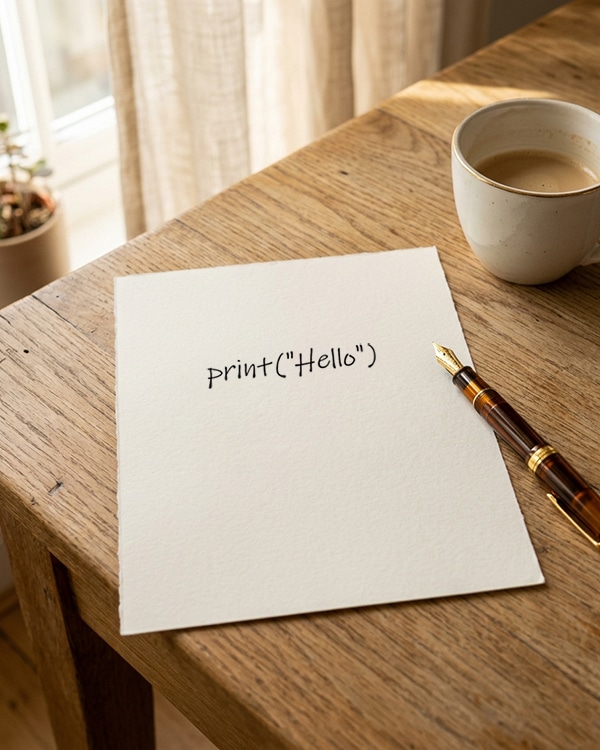
print(“Hello, Feloriya.”)
# Output: Hello, Feloriya.
The print() function is your voice. Whatever you place inside the parentheses, Python will show it to you. Try changing the text inside the quotes. Write your name. Write a question. Python will answer.
Common Mistakes
- Forgetting the quotes around text print(Hello) causes an error
- Missing parentheses print “Hello” works in Python 2 but not in Python 3
- Mixing single and double quotes without closing them print(‘Hello”)
- Using capital P Print(“Hello”) because Python is case sensitive
⚠️ Python is case sensitive. Print() with a capital P will fail. Always use lowercase print(). Also remember that text must always be inside quotes, but numbers do not need quotes.
⚡ Whisper
Every journey begins with a single word spoken into the void. This Python introduction for beginners is your first step. Print your first message. Let the machine hear you. Then listen as it whispers back. Tomorrow, we will learn about numbers and variables. But for now, just speak.


